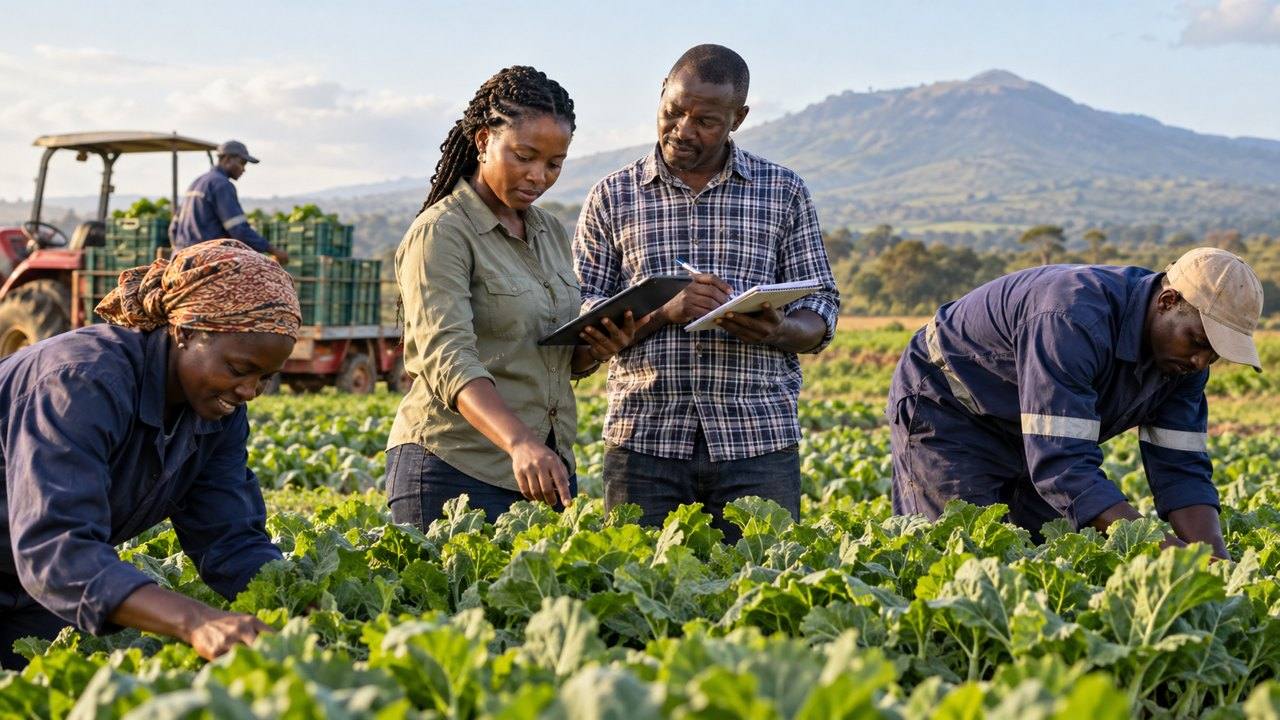
The continent's largest employer
The ILO estimates that agrifood systems, from production to distribution, employ 65.4% of the African workforce, against 41.5% in Asia and 22.4% in the Americas. At least 52% of Africans live in rural areas.
Countries where the land employs almost everyone
Agriculture's share of employment reaches 60 to 85% in Burundi, the Central African Republic, Chad, Angola, Malawi, Mozambique and Madagascar. In Burundi, the World Bank refers to more than 85% of workers in subsistence farming.
A gradual decline in favour of services
ILOSTAT projected an agricultural share of around half of employment in 2023, against 58% before 2000. The sharpest fall, 13 points, affects West Africa, including Ghana and Nigeria. In Southern Africa, it would drop to 9%.
Widespread informality on farms
According to an ILO estimate for 2025, informal employment exceeds 90% of African agricultural employment. Unpaid family work, seasonal day labourers and smallholders dominate, hence the value of targeting structured companies to secure a contract.
Agribusiness, a source of more skilled jobs
The ILO stresses that the processing and distribution links offer more productive jobs, but fewer of them. The AfDB presents agribusiness as an outlet for young people, and these roles often overlap with retail and sales.
AfDB projects in several countries
The AfDB has announced USD 211 million for agriculture and employment in eastern Angola, a USD 300 million youth programme with Nigeria, and the Agropole-Nord in Senegal, an agro-industrial processing zone.
Land, irrigation and untapped potential
Africa holds 60% of the world's uncultivated arable land, but only around 6% of cultivable land is irrigated. Hydraulic engineers, irrigation technicians and agronomists specialising in water management will find a lasting field of activity there.
Agricultural NGOs: the example of One Acre Fund
In 2024, One Acre Fund was the organisation posting the most development vacancies in Kenya on Devex, with 53 ads in twelve months. Agricultural NGOs recruit field officers, trainers and analysts, see employment in Kenya.
Madagascar and the Indian Ocean
In Madagascar, agriculture employs between 60 and 85% of workers according to the ILO. Salaried vacancies are rare compared with this mass of workers, and the activity of the PortalJob site could not be verified: cross-check several sources.
Wage floors in the fields
In Tanzania, the monthly minimum wage for crops and livestock has been set at 175,000 shillings since January 2026. In Mozambique, the agricultural floor has stood at 6,688 meticais since July 2025, among the lowest on the national scale.
Roles in demand in agricultural value chains
Agronomists, vets, production technicians, quality managers, machine operators, stock managers and input sales staff make up most salaried vacancies. A command of export health standards is an asset sought by processors.
Agricultural exports and related jobs
In the COMESA region, agriculture accounts for around 65% of export earnings, according to the ILO. Certification, cold-chain logistics, quality control and commodity trading generate jobs in towns, far from the farms themselves.
Organisations and sites for agricultural jobs
- Banque africaine de développement (BAD): African Development Bank financing job-creating agricultural and agro-industrial programmes, notably in Angola, Nigeria and Senegal.
- One Acre Fund: Agricultural NGO that posted 53 development vacancies in Kenya over twelve months in 2024, according to Devex.
- Go Zambia Jobs: Zambian portal for jobs and tenders, in a country where agriculture provided 28% of jobs in 2024.
- Emprego.co.mz: Mozambican job site where WFP, the United Nations and large local companies post vacancies.
- BrighterMonday Uganda: Ugandan portal listing 568 vacancies on 9 October 2026, in a country where agriculture was the leading employment sector in 2021.
- NGO Jobs in Africa: NGO job site covering around 40 countries, useful for rural development and food security posts.
Building a career in agribusiness
- Define your target value chain: crop production, livestock, processing, irrigation, inputs or marketing.
- Highlight an agricultural degree or technical certification, backed by placements on farms or in factories.
- Identify processors, structured cooperatives, agricultural NGOs and donor-funded projects in your region.
- Follow national job boards and development platforms for agronomist, technician or project manager posts.
- Showcase measurable results: yields, areas monitored, farmers trained, volumes processed.
- Check the written contract, whether the post is seasonal or permanent, and compliance with the agricultural minimum wage.
Reference data on agricultural employment
| Indicator | Value | Source and date |
|---|---|---|
| Agriculture's share of African employment | More than 50% | ILO, October 2025 |
| Informality in agricultural employment | More than 90% | ILO, 2025 estimate |
| Workforce in agrifood systems | 65.4% | ILO, 2025 |
| Agricultural minimum wage in Tanzania | TZS 175,000 per month | Order GN 605A, January 2026 |
| Agricultural minimum wage in Mozambique | MZN 6,688 per month | INSS, July 2025 |
| Irrigated cultivable land | Around 6% | ILO, 2025 |
Supporting documents for a salaried farm job
- CV listing value chains, crops and areas managed
- Legalised agronomy, agricultural technician or veterinary diploma
- Certificates of placements on farms or in processing units
- Driving licence for field posts
- Medical certificate for jobs in food processing plants
- Work permit for a post outside your home country
What to avoid in agricultural employment
- Paying an intermediary for a seasonal work contract abroad: fake fruit-picking programmes are a widespread scam.
- Accepting farm work without a written contract, without knowing the applicable minimum wage or the real length of the season.
- Going to work on a foreign plantation with only a tourist visa, without a valid work permit.
- Neglecting sanitary and phytosanitary standards, a command of which sets candidates apart in exporting companies.
- Focusing only on production, when processing, logistics and trading offer more salaried jobs.
Your queries on farming careers
Is agriculture the largest employment sector in Africa?
Yes. According to the ILO, agriculture provides more than 50% of the continent's jobs, and agrifood systems as a whole employ 65.4% of the workforce. This share is nonetheless slowly declining, especially in West Africa according to ILOSTAT.
Which agribusiness roles are recruiting?
Processors and exporters look for agronomists, quality managers, production technicians, machine operators, stock managers and sales staff. NGOs and development projects also employ field officers, trainers and monitoring and evaluation specialists.
What is the agricultural minimum wage in Tanzania?
Since 1 January 2026, the Tanzanian private sector scale has set 175,000 shillings per month for crops and livestock. This is well below the minimums for mining, at 695,000 shillings, or commercial banks, at 733,000 shillings.
Why is agricultural employment so informal?
According to the ILO, more than 90% of African agricultural employment is informal, because production relies on small family farms and seasonal workers. Declared jobs are concentrated in structured plantations, processing and development organisations.
Official sources
OIT : agriculture et emploi décentilo.org
BAD : l'agro-industrie et les jeunesafdb.org
BAD : Agropole-Nord au Sénégalafdb.org
ILOSTAT : un emploi africain en mutationilostat.ilo.org
Information up to date as of October 2026. AfriqueJob.com does not recruit and never asks for money: beware of offers that demand fees.